|
|
  Monumenti Monumenti
La
Torre Pendente
 Visita
la Torre Visita
la Torre
Restauro
della Torre
Interventi
passati
Il
Campanile
Duomo
Battistero |
|
|
 |
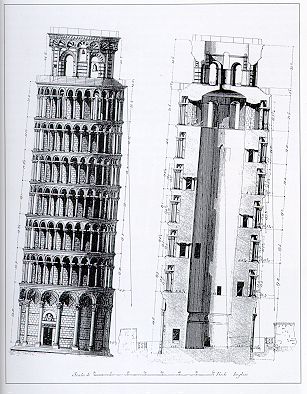 |
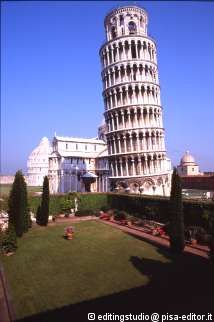
The construction begun in 1173 and it must have been
suspended at the completion of the third ring, around ten years later, since a subsidence
of the soil of between 30 and 40 cm. had thrown the tower out of the perpendicular,
causing an initial overhang of circa 5 cm. More than a century after the laying of the
foundation stone, was once again begun (1275) by Giovanni di Simone, who added three more
levels, correcting the axis of the Campanile. In 1284 the six stories of loggias were to
all effects finished, bringing the height of the building to 48 m., and employing a
technical expedient that was meant to diminish, at least optically, the effects of the
inclination, accomplished by raising the galleries of the upper floors on that side. |
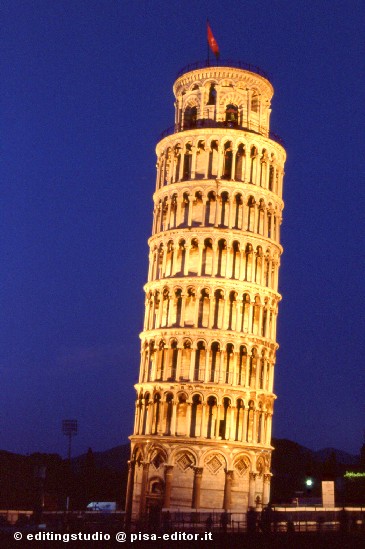
At the time the inclination of the Tower
was more than 90 cm. The tormented vicissitudes of the Tower did not, as one might expect,
greatly worry those who were involved in the construction and completion. The long
intervals between building activity were dictated, most likely, by the need of letting the
Campanile 'rest', but above all by letting both the foundations and the ground on which
they rested settle down. |
 |
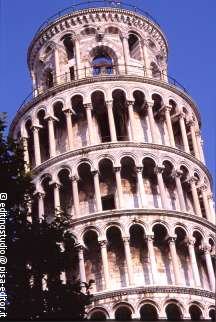 |
In a certain sense it can be said that the subsidence of the
soil and the consequent inclination had, on the whole, been foreseen. At the beginning of
the 14th century the bells were placed at the sixth level, in the large opening
still visible in the marble cylinder beyond the loggia. Between 1350 and 1372 Tommaso di
Andrea Pisano (according to Vasari) terminated the installation of the belfry on the
summit of the sixth order of loggias, increasing the correction of the axis, and thus
diminishing the load on the side that was in inclination, which in the mean while had
become fixed at 1.43 m. |
Conceived of not only as a bell tower, but
also as a belvedere for the square below - from the earliest times the loggias have served
as 'grandstand' for religious events and fairs - it rises 58.36 m above the level of the
foundation, just under 56 m over the level of the countryside, and its inclination,
measured at the base, is over 4 m. The average subsidence of the base is 2.25 m, while the
progressio of the overhang, despite all attempts so far made to bring it to a halt, is
about 1.2 mm per year. |
 |
 |
|
|
|
|
|
|




















 The Leaning Tower